How a BrainRx Training Program Can Support Better Learning and Thinking Skills

Why does one child remember everything they hear while another forgets instructions within minutes? Why can some children concentrate on homework for an hour while others struggle to stay focused for ten minutes?
These differences do not always come down to effort or motivation. Learning depends on several cognitive skills, including attention, memory, processing speed, reasoning, and the ability to make connections between information. When some of these skills are weaker, everyday schoolwork can feel much harder than it should.
This is where a structured BrainRx Training program can provide additional support.
What Is a Brain Skills Development Program?
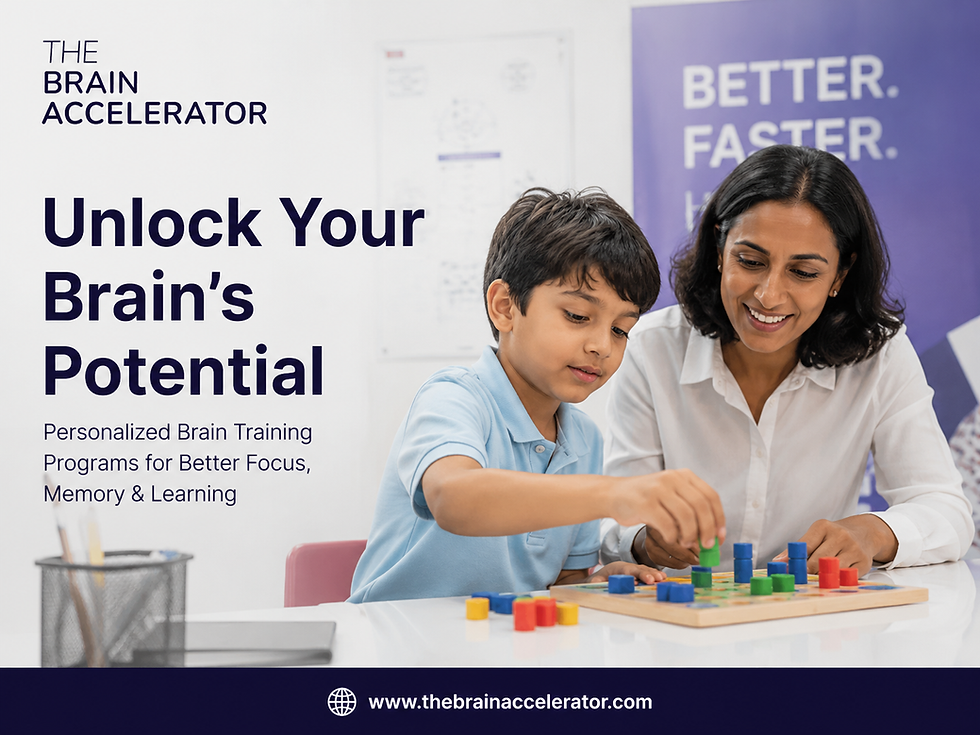
Brain training focuses on the skills that support learning rather than simply repeating school subjects. Activities may target attention, working memory, long-term memory, processing speed, auditory processing, visual processing, and reasoning.
The idea is straightforward. Instead of only helping a child complete today's homework, training works on abilities that can help them approach future learning more effectively.
A personalised approach is particularly important because two children with similar academic difficulties may have very different underlying challenges.
Can Brain Training Improve Critical Thinking Skills?
Critical thinking is not a single ability. It involves remembering information, identifying patterns, comparing ideas, solving problems, and making decisions.
Training activities that challenge memory, reasoning, attention, and processing can help develop some of the cognitive foundations used during these tasks. This can be particularly useful for learners who understand concepts but struggle to organise information or work through problems independently.
The goal is not to provide shortcuts to the correct answer. It is to help learners develop stronger skills for approaching problems.
How Can Brain Training Support Reading, Memory, and Maths?
Academic difficulties can sometimes be connected to cognitive skills that sit behind a particular subject.
For example, reading and spelling require learners to process sounds, remember information, and maintain attention. Maths can place demands on working memory, reasoning, and processing speed. If these underlying skills are difficult for a child, additional tutoring may not address the entire challenge.
Brain training can complement academic teaching by focusing on these supporting skills. It should not be viewed as a replacement for classroom instruction, tutoring, or specialist support where those are appropriate.
Who Can Benefit From Brain Training Dubai Programs?
Brain training is not limited to children who are struggling at school. Younger learners may need support with attention and learning readiness, while older children and teenagers may want to strengthen memory, processing speed, or reasoning.
Gifted and high-achieving students can also work on cognitive skills to support demanding academic environments. Adults may explore training for areas such as memory, focus, and mental processing.
Families considering brain training Dubai options should look for an approach that starts by understanding the learner rather than applying the same activities to everyone.
What Should Parents Look For?
A useful starting point is an assessment. It can help identify a learner's strengths and areas that may require additional attention.
BrainRx approach at The Brain Accelerator follows this model, beginning with a cognitive skills assessment before creating personalised training. Sessions use one-on-one coaching and targeted exercises focused on areas such as memory, attention, processing, and reasoning.
Parents should also look for clear progress tracking and realistic expectations instead of promises of instant academic results.
Common Questions Parents Ask
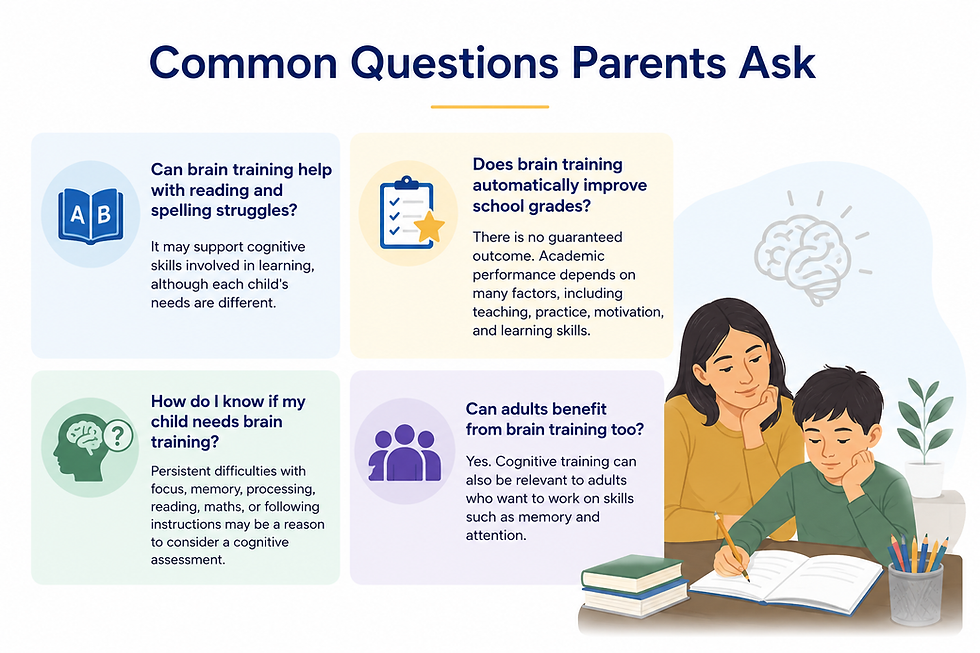
Can brain training help with reading and spelling struggles? It may support cognitive skills involved in learning, although each child's needs are different.
Does brain training automatically improve school grades? There is no guaranteed outcome. Academic performance depends on many factors, including teaching, practice, motivation, and learning skills.
How do I know if my child needs brain training? Persistent difficulties with focus, memory, processing, reading, maths, or following instructions may be a reason to consider a cognitive assessment.
Can adults benefit from brain training too? Yes. Cognitive training can also be relevant to adults who want to work on skills such as memory and attention.
Giving Learners a Stronger Foundation
Every learner has a different combination of strengths and challenges. Understanding those differences can be more useful than simply adding more hours of homework or tutoring.
For parents researching a brain training center, the priority should be finding an approach that assesses individual needs, targets relevant cognitive skills, and measures progress over time. Whether families discover options through recommendations, or social media channels, informed decisions should come before choosing a program.
When cognitive training works alongside appropriate academic support, it can give learners another pathway to build confidence, approach challenges more effectively, and develop skills that support learning both inside and outside the classroom.
Comments